
Crown and Bridge
Save the tooth you have. Replace the one you don’t.
A dental crown is a custom-made cap placed over a damaged or weakened tooth to restore its strength, shape, and appearance. It’s typically used when a tooth is cracked, worn, or has had a large filling or root canal.
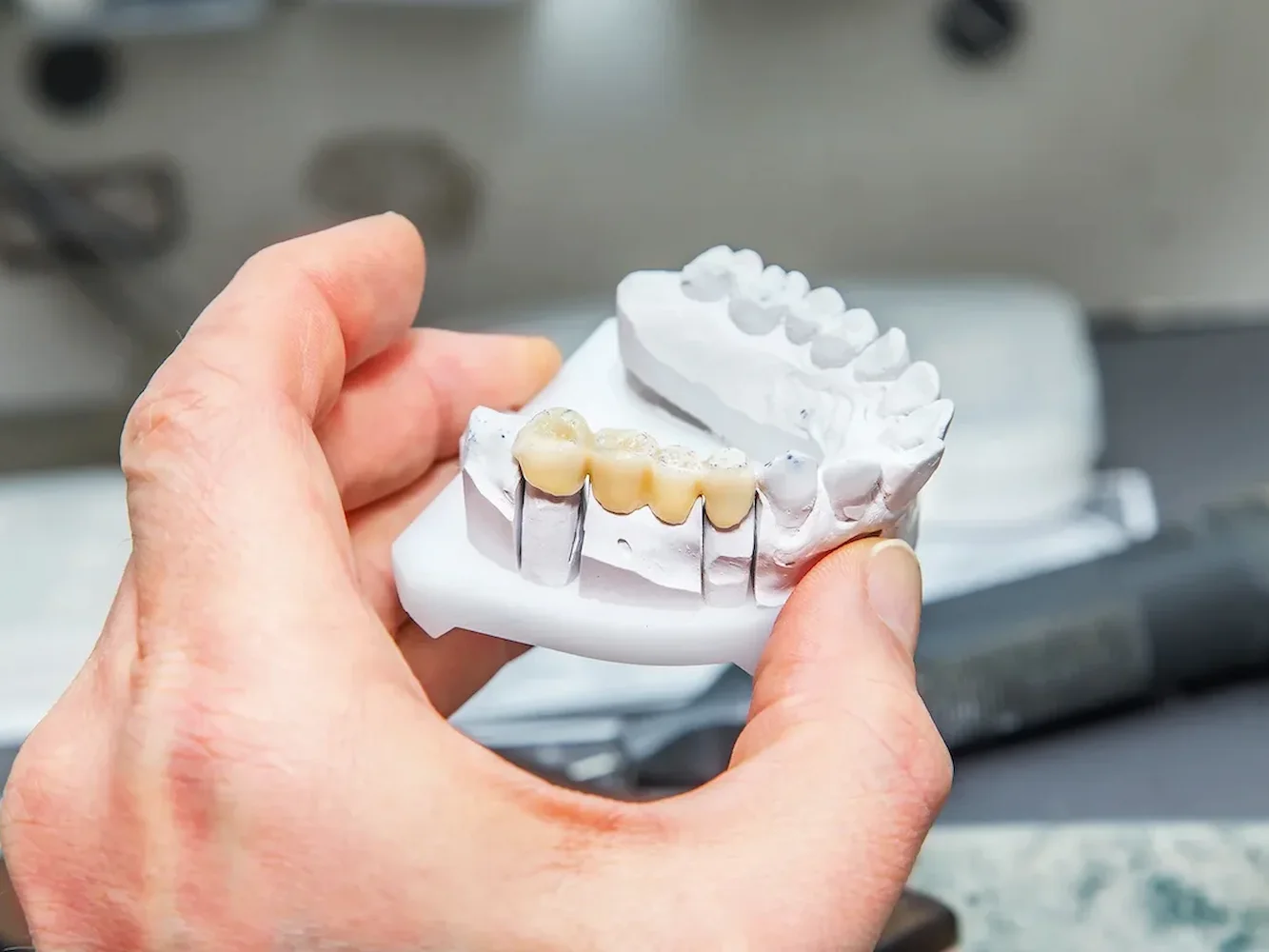
A dental bridge, on the other hand, is used to replace one or more missing teeth by anchoring an artificial tooth to the natural teeth or crowns on either side of the gap. While crowns protect existing teeth, bridges fill spaces left by missing ones, helping restore function, alignment, and a complete, confident smile.
At EZ Dental Studio in Wexford, PA, every crown and bridge is designed for your bite and shade-matched to the teeth around it — so the restored tooth blends in rather than announcing itself.
Crowns and Bridges at EZ Dental Studio
Our starting position is always to keep your own tooth if keeping it is realistic. A crown is often what makes that possible: it protects a cracked or heavily filled tooth from splitting, which is the failure that turns a restorable tooth into an extraction.
When a tooth is already gone, we walk you through both a bridge and an implant honestly, including the trade-offs each one carries. A bridge is faster and requires no surgery, but it means preparing two healthy neighbors. An implant leaves them alone. Which is better depends entirely on your situation, not on a policy.
Porcelain Crowns
All-ceramic crowns for front teeth and visible areas, where translucency and shade matching decide whether the result looks natural. Metal-free, biocompatible, and highly stain-resistant.
Zirconia and Full-Coverage Crowns
Exceptionally strong crowns for molars and for patients who grind. They stand up to years of heavy chewing forces without chipping.
Dental Bridges
A fixed, non-removable replacement for one or more missing teeth in a row, supported either by crowned natural teeth or by dental implants.
Benefits of a Crown
A crown is usually recommended when a tooth has a crack running through it, has lost too much structure for a filling to hold, has had root canal treatment, or is worn down from grinding.
- Strengthens and protects your natural tooth
- Restores full function (bite and chewing)
- Natural appearance (blends with surrounding teeth)
- Long-lasting with proper care
- Holds a cracked tooth together and prevents the fracture from spreading
- Corrects a discolored or misshapen tooth that bonding cannot fix
Benefits of a Bridge
- Fills gaps and restores your smile
- Prevents shifting of nearby teeth
- Improves chewing and speaking
- Fixed (non-removable) option compared to dentures
- Stops the opposing tooth from over-erupting into the empty space
- Keeps your bite from collapsing unevenly over time
A bridge works best when the teeth on either side of the gap are strong enough to carry it. Most bridges replace one to three teeth in a row; longer spans put more strain on the anchors and are often better served by implants.

When Is One Used Over the Other?
If you’re deciding between options, it often comes down to whether the tooth is still present and strong enough to be restored or already missing. When a tooth can be saved, a crown is typically recommended to protect and reinforce it, helping maintain natural function and appearance.
If the tooth is no longer there, a bridge can effectively fill the gap by using nearby teeth for support. However, dental implants are another excellent option, offering a long-lasting, natural-feeling solution that doesn’t rely on surrounding teeth for stability or support.
The trade-off is straightforward. A bridge is quicker and needs no healing period, but it commits two healthy teeth to being crowned permanently. An implant preserves those teeth and the bone in the gap, at the cost of a longer timeline. We lay both plans out side by side, with figures, so you can decide with real information. Read more about dental implants.
What Is The Treatment Process
Most crown and bridge cases follow this sequence:
- Examination and digital imaging to confirm the tooth is restorable
- Shade selection and bite analysis so the restoration matches and functions correctly
- Preparation of the tooth and a precise digital or physical impression
- A well-fitted temporary crown or bridge while the lab fabricates the final piece
- Fitting, adjustment, and permanent cementation of the finished restoration
Most cases are complete in two visits over two to three weeks. We check contacts and bite carefully before cementing — a crown that sits even slightly high causes soreness that no amount of getting used to will fix.

Comfortable From Start to Finish
Crown appointments are routine and done under local anesthetic, so the procedure itself is comfortable. If dental anxiety is the reason a cracked tooth has gone untreated for months, we can address that too.
Oral sedation and nitrous oxide are both available at EZ Dental Studio. Learn more about sedation dentistry.
Why Choose EZ Dental Studio?
Dr. Erich Zimmermann, DDS, FICOI, restores crowns and bridges with the same attention to shade, contour, and margin detail that goes into cosmetic work — because a molar crown is visible every time you laugh.
Our restorations are made by a high-end ceramic laboratory rather than pulled from a stock catalog, and adjustments are done in-house. You will see the same dentist from the first appointment to final cementation.
Crowns and Bridges: Common Questions
How long do crowns and bridges last?
With good hygiene and regular checkups, ten to fifteen years is typical, and many last considerably longer. Grinding, gum disease, and decay at the margin are what shorten that span.
Does getting a crown hurt?
The appointment is done under local anesthetic and is generally comfortable. Mild sensitivity for a few days afterward is normal and settles on its own.
Will the crown match my other teeth?
That is the goal, and it is why shade selection happens before preparation and in good light. Porcelain and zirconia can be layered to reproduce the translucency and subtle variation of natural enamel.
Can a crowned tooth still get a cavity?
The crown cannot decay, but the natural tooth beneath it can — most often right at the gum line where the crown meets the tooth. Flossing that margin daily matters more than people expect.
How much do crowns and bridges cost?
It depends on the material, the number of units, and whether any groundwork like a root canal or buildup is needed first. You receive a written treatment plan with exact costs before we start.
Does insurance cover crowns and bridges?
Usually, at least partially — these are restorative rather than cosmetic procedures. Annual maximums and waiting periods vary by plan, and our team will verify your benefits in advance.
What is the difference between a crown and a cap?
They are the same thing. “Cap” is the older everyday term for what dentists call a crown.
Do I need a root canal before a crown?
Not always. A root canal is only necessary when the nerve inside the tooth is infected or dying. Many teeth are crowned with a perfectly healthy nerve intact.
Can I eat normally with a bridge?
Yes, once it is cemented. You will need to clean underneath it with floss threaders or an interdental brush, since food can collect below the replacement tooth.
What if my temporary crown comes off?
Call us and we will re-seat it. Avoid chewing on that side and skip sticky foods until it is back in place, since the prepared tooth underneath can be sensitive.
Are metal-free crowns as strong as metal ones?
Modern zirconia is strong enough for molars and heavy grinders in nearly all cases. We choose the material based on which tooth it is and how hard you bite.
Contact Us To Improve Your Smile!
If you’re considering dental crowns or bridges, contact EZ Dental today. Our friendly team is ready to answer your questions, explain your options, and help you restore a strong, confident, and healthy smile.
10317 Perry Hwy, Wexford, PA 15090